Crosshair Analyzer – Valorant CV
Comparative benchmark of YOLO, FastSAM, and RTDETR for real-time player detection in Valorant — proving segmentation models achieve pixel-level accuracy at 60 FPS.
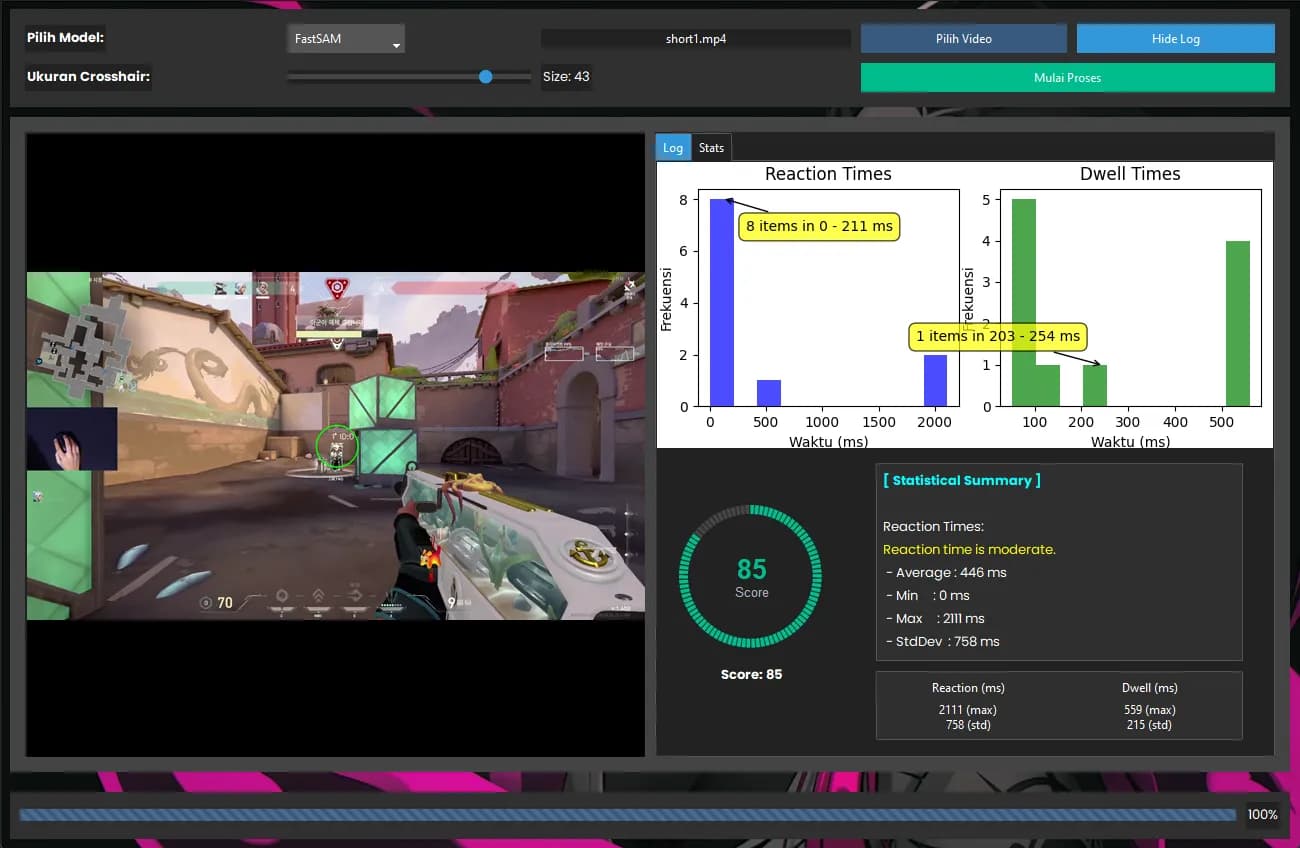
System Architecture
Overview
A model testing framework that benchmarks three computer vision architectures — YOLO, FastSAM, and RTDETR — for real-time object detection in Valorant gameplay footage.
Problem Statement
Standard object detection (bounding boxes) lacks precision for in-game player detection where pixel-level accuracy matters. The question: which CV architecture handles Valorant's visual complexity best?
Solution & Approach
Head-to-head comparison of three models on real gameplay footage at 60 FPS. FastSAM's segmentation approach produces pixel-level masks instead of rough bounding boxes, making it far more accurate for detecting player models against complex game environments.
Key Features
- FastSAM segmentation: 93.4% mAP — pixel-level detection outperforms bounding-box models
- YOLO object detection: fastest at 70-80 FPS but struggles with overlapping targets
- RTDETR transformer: high precision on isolated targets but slower at 35-45 FPS
- Foundation for building a real-time Valorant player detection system at pixel level
Results & Impact
Segmentation (FastSAM) proved significantly more accurate than pure object detection (YOLO) for in-game scenarios — confirming that pixel-level masks are the right approach for game vision systems.
Lessons Learned
For accurate game detection, segmentation models beat traditional object detection. This benchmark validates FastSAM as a viable foundation for building real-time player detection tools in competitive FPS games.